

How do you describe an experience you have no words for?

Morning,
How do you describe an experience that you have no words for? That is a fundamental question within my book Hulp to Hope, which I’ve just finished a round of developmental edits on. More on that very soon.
For me, the answer has always been poetry.
Right now, though, I’ve been resisting sitting down to write anything at all. It doesn’t feel like any words can words adequately contain what we are witnessing in the world.
So what do we do with that silence?
Does poetry fail us?
Palestinian poet Mohammed Moussa wrote last year: “I’ve learned that Palestinians, especially Gazans, must constantly reshape their language, forging new names and meanings for their pain to make the world grasp what they endure.”
Any experience that dehumanises - that others us - also silences us. Because there are no existing words to hold it.
I have been working on a podcast, Words in the Wilderness, which launches very soon. The trailer is out this week, and in it we speak directly to this. Childhood sexual abuse survivor Sophie Olsen, featured in episode 9, said of her experience:
“I still wanted to speak. I wanted to be able to say it. And I just couldn’t say the words. I couldn’t say the word abuse.”
Mohammed wrote poems. Sophie wrote poems.
Dr. Stephanie Aspin, author of Poetry and Therapy and a guest on the podcast, put it like this:
“Why I think poetry is so important - poetic language more generally - is that it is multiple. When we come into therapy, often it’s a process of tolerating that there isn’t a simple answer. What poetry can do is give us different ways of thinking about things. Poetry has built into it multiple meanings, but when we’re speaking we tend to adhere to a singular meaning.”
This is why so many of us turn to it in times of struggle and trauma. Poetry holds both what is and what cannot be; what is said, and what is meant.
So what can we do when we cannot find words at all? When we cannot even make marks on a page to describe the confusion of feelings we are grappling with?
This is where found poetry can help - forms like Dadaist poetry and blackout poetry. Dadaist poetry emerged around 1916, in the midst of WWI, as a response to the chaos of a world in conflict. It involves taking already-written text, cutting up the words, placing them into a bag, and pulling them out at random - letting chance become the author. Sound poetry works similarly, prioritising the texture of language over its meaning.
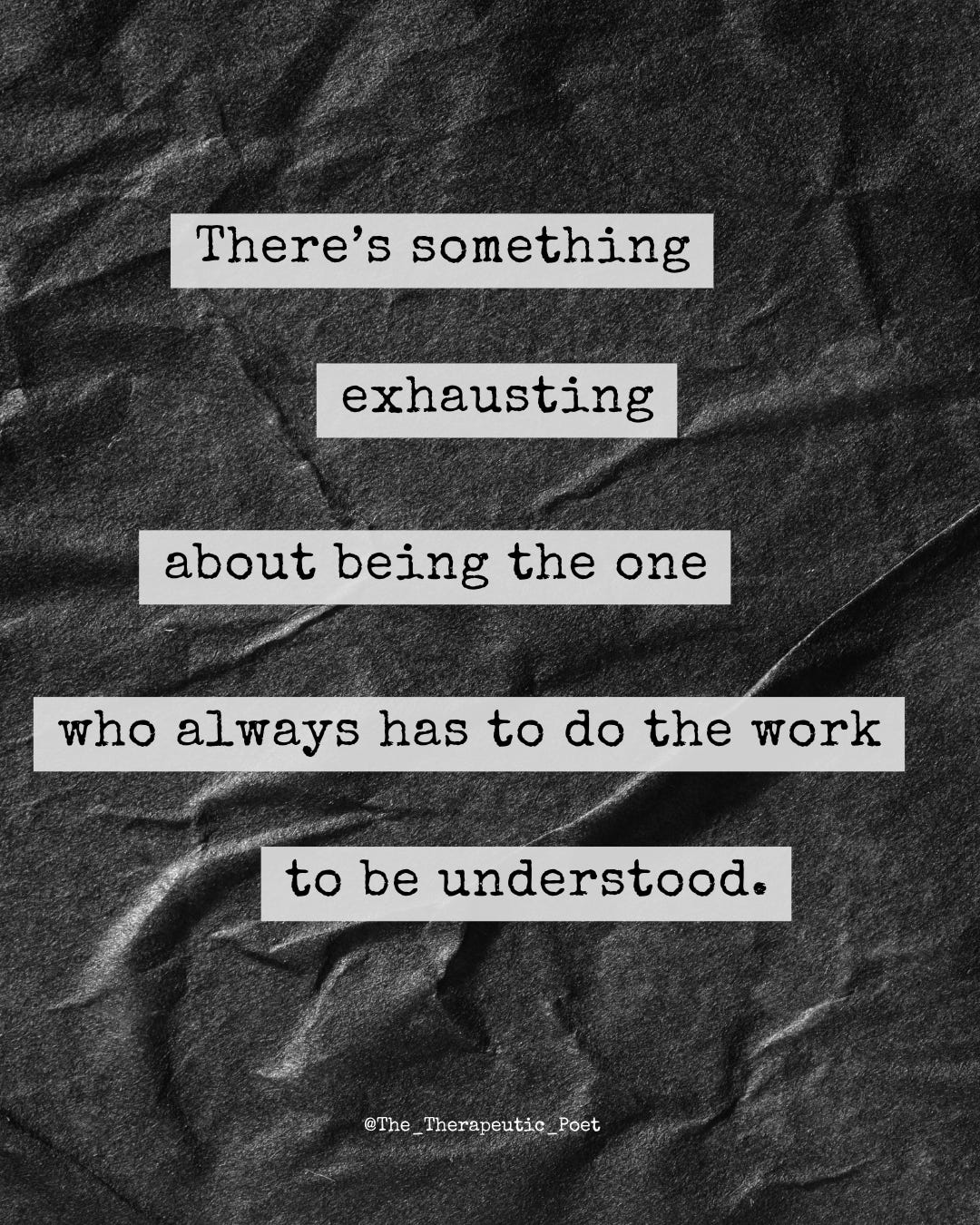
Blackout poetry is another form, and one I have used myself, working with a final message left behind by Palestinian journalist Anas Jamal Al-Sharif. Dr. Aspin also shared a practice one of her clients used: writing their experience as if it were a newspaper headline. Sometimes we need the container before we can find the content.
I always say that poetry is about transcribing your human experience as closely as you can onto the page. Before you concern yourself with whether it is good, check in with whether it feels true. And that can be as much about how you create as what you create. Sometimes it is oh so true to not have the words, but to pick through remnants of resonance from what others say.
If you are feeling unanchored, untethered — as one catastrophic news cycle rolls into the next — these techniques may offer a small point of grounding.
This is so needed right now. In a VUCA world, one that is volatile, uncertain, complex, and ambiguous, we are called to have vision, understanding, clarity and agility. Poetry, art, creativity: these are, I believe, a path toward that.
If you are curious, then today I have given a prompt below for you to have a go at some blackout poetry.
Meanwhile, I also have news!
🎙️ Words in the Wilderness, my new podcast, launches soon. This is a transition from the currently named ‘The Therapeutic Poet podcast’ The trailer drops this week. Here’s a sneaky peek.
I’d love for you to subscribe to the podcast so you are notified when the new epsiodes begin and to join me in the conversation.
📖 Hulp to Hope is coming. Watch this space.
🌿 And if grief has been sitting with you lately, even if it is anticipatory grief of some kind — you’re not alone. Join me for my next poetry workshop on 17th March, where we’ll write into grief together, gently and without pressure.
Today’s prompt: Take a piece of text,
Keep reading with a 7-day free trial
Subscribe to Jacky Power | The Therapeutic Poet to keep reading this post and get 7 days of free access to the full post archives.